




Do not hesitate to ask us all the questions you have in mind, we are just a click away for all kinds of questions and information. Call us now and let us answer your questions.
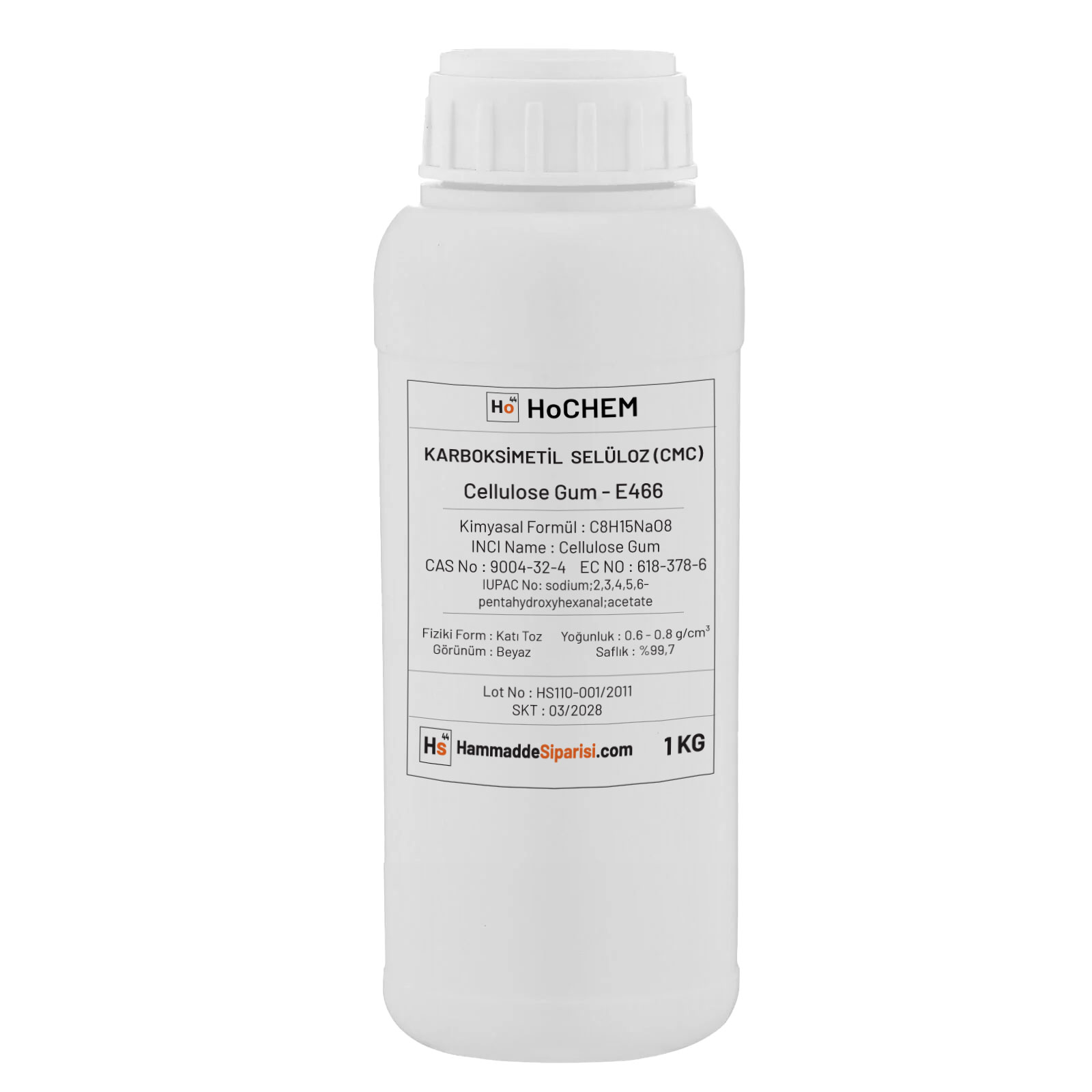
Carboxymethyl Cellulose | Cellulose Gum | 9004-32-4 | E466
Price range: 295.00 ₺ through 395.00 ₺
Carboxymethyl cellulose (CMC), is a water-soluble polymer obtained by chemical modification of natural cellulose with carboxymethyl groups. It is widely used as a thickener, stabilizer and emulsifier. CMC, plays an important role especially in food, pharmaceutical, cosmetic and industrial products.
- Chemical Name: Carboxymethyl Cellulose
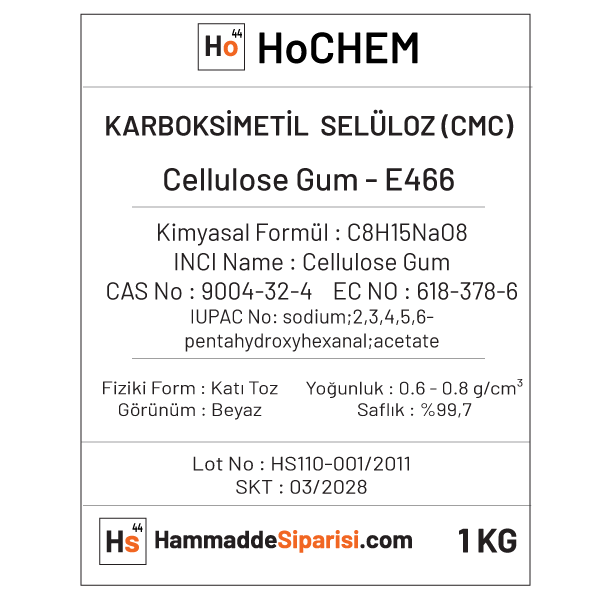
- INCI Name: Cellulose Gum
- Pearl Name: Cellulose Gum
- General Trade Name: CMC, Cellulose Gum, Tylose
- English Name: Carboxymethyl Cellulose, Sodium carboxymethyl cellulose
- Turkish Name: Carboxymethyl Cellulose
- CAS Number: 9004-32-4
- EC Number: 618-378-6
- IUPAC Number: Sodium carboxymethylcellulose
- E Food Code: E466
Detailed Information About Carboxymethyl Cellulose (CMC)
General Information of the Product
- Chemical Name: Carboxymethyl Cellulose
- INCI Name: Cellulose Gum
- Pearl Name: Cellulose Gum
- General Trade Name: CMC, Cellulose Gum, Tylose
- English Name: Carboxymethyl Cellulose, Sodium carboxymethyl cellulose
- Turkish Name: Carboxymethyl Cellulose
- CAS Number: 9004-32-4
- EC Number: 618-378-6
- IUPAC Number: Sodium carboxymethylcellulose
- E Food Code: E466
1. Brief Description of the Product
 Carboxymethyl cellulose (CMC), is a water-soluble polymer obtained by chemical modification of natural cellulose with carboxymethyl groups. CMC is widely used as a thickener, stabilizer and emulsifier, especially in food, cosmetics and industrial products plays an important role.
2. Areas of Use and Usage Rates of the Product
Food Industry:
- Areas of Use: Thickener and stabilizer in yoghurt, ice cream, ready-made soups, sauces and confectionery.
- Usage Rate: %0.1 – %2.
Cosmetics and Personal Care:
- Uses: Viscosity increaser and stabilizer in toothpaste, shampoo, facial cleansers and skin care products.
- Usage Rate: %0.5 – %5.
Oil and Drilling Industry:
- Areas of Use: To provide mud stability in drilling fluids.
- Usage Rate: %0.5 – %3.
Paper and Textile Industry:
- Areas of Use: Binder in paper coatings, stabilizer in textile dyes.
- Usage Rate: %0.5 – %3.
3. Physical Properties of the Product
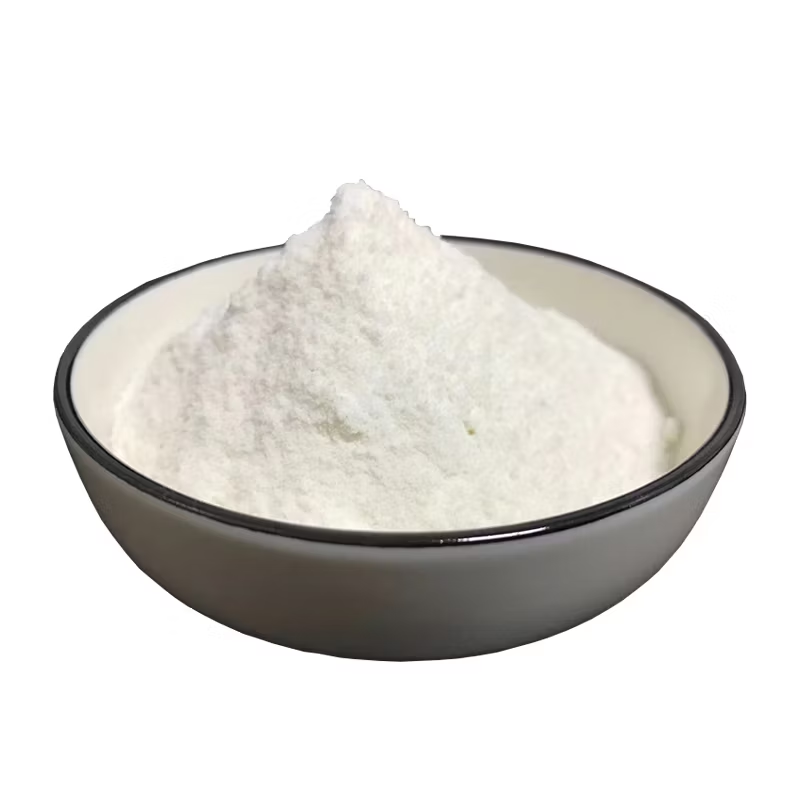
- Physical Condition: White powder
- Colour: White or light cream
- Smell: Odorless
- pH Value: 6.5 – 8.0 (1% aqueous solution)
- Resolution: Water soluble
- Melting Point: Not applicable
- Intensity: 0.5 – 0.7 g/cm³
4. Chemical Properties and Molecular Formula of the Product
- Chemical Formula: C8H16NaO8
- Chemical Group: Cellulose derivative
- Chemical Reactivity: It is resistant to most acids and bases, but its solubility may be affected by extreme temperatures.
5. Other Names of the Product
- Turkish Names: Carboxymethyl Cellulose, Sodium Carboxymethyl Cellulose
- English Names: Cellulose Gum, Sodium Carboxymethyl Cellulose, Tylose
2,3,4,5,6-pentahydroxyhexanal acetic acid sodium hydride
acetic acid; 2,3,4,5,6-pentahydroxyhexanal; sodium
Carboximethylcellulose
Carboxymethylcellulose
Carboxymethyl cellulose
Carboxymethyl Cellulose Sodium
Carboxymethyl cellulose sodium salt
Carboxymethyl cellulose, sodium salt
Carboxymethylcellulose
carboxymethylcellulose
Carboxymethylcellulose sodium salt
Cellulose carboxymethyl ether sodium salt
Cellulose Gum
Cellulose gum
Cellulose, carboxymethyl ether, sodium salt
Na carboxymethyl cellulose
sodium carboxy methyl cellulose
sodium carboxyl methyl cellulose
SODIUM CARBOXYMETHYL CELLULOSE
Sodium Carboxymethylcellulose
Sodium carboxymethylcellulose
sodium cellulose carboxymethyl ether
6. Useful Links
7. Product Safety and Storage Information
Security Information:
- Avoid contact with eyes and skin.
- Avoid breathing the dust form.
- If accidentally swallowed, rinse mouth with plenty of water and consult a physician.
Storage Information:
- It should be stored in a cool and dry environment, below 25°C.
- It should be kept away from direct sunlight.
- It should be kept in closed packaging, protected from moisture.
8. Remarkable Information About the Product
- It is known in the food industry as E466.
- It prevents the formation of ice crystals in ice cream and has a thickening effect.
- It is biodegradable as an environmentally friendly material.
- It is preferred in cosmetic formulations due to its skin compatibility.
9. Frequently Asked Questions and Answers About the Product
1. Is carboxymethyl cellulose natural or synthetic?
- It is a semi-synthetic polymer. It is produced from natural cellulose, but obtained by chemical modification.
2. Is CMC safe?
- Yes, it is considered safe when used in accordance with international regulations.
3. In which products is carboxymethyl cellulose found?
- It can be found in many products such as yogurt, ice cream, sauces, toothpaste, and shampoo.
4. What is the environmental impact of CMC?
- It is biodegradable and environmentally friendly.
5. At what temperatures is CMC stable?
- Generally stable in the range of 25-60°C; solubility may be affected at higher temperatures.
6. Is carboxymethyl cellulose harmful to human health?
- It is not harmful to health when used as a food additive in the specified proportions.
7. What forms does carboxymethyl cellulose exist in?
- It is commercially available in powder or granular form.
8. In which industries is it used most frequently?
- It is widely used in the food, cosmetics, pharmaceutical, paper, textile and petroleum industries.
9. Is carboxymethyl cellulose vegan?
- Yes, it is vegan-friendly as it is produced from plant-based cellulose.
10. What should be taken into consideration during storage?
- It should be stored in a dry and cool place, away from humid environments and direct sunlight.
| Weight | 1 kg |
|---|---|
| Case NO | 9004-32-4 |
| INCI Name | Cellulose Gum |
| PEARL Name | Cellulose Gum |
| English Name | Carboxymethyl cellulose |
| Amount | 1 Kg, 500 Gram |
| Brand | HoChem Chemistry |
| Food Code | E466 |
Sample Formula
Sample Product Made with Carboxymethyl Cellulose:
Gel Based Cleaner
Materials
| Material | Quantity (%) | Position / Description |
|---|---|---|
| Water (deionized) | 80 | Solvent, carrier medium |
| Carboxymethyl Cellulose (CMS) | 1.5 | Gel forming and viscosity increasing agent |
| Glycerine | 5 | Humectant and softener |
| Citric acid | 0.2 | pH balancer |
| Anionic Surfactant | 8 | Cleaning agent |
| Preservative (e.g. Benzisothiazolinone) | 0.3 | Extending the shelf life of the product |
| Fragrance and Colorant | qs | Aesthetics and user experience |
Production Steps
- Preparation:
- Deionized water is taken into a clean and sterile mixing tank.
- The mixer is operated at low speed.
- Adding CMS:
- CMS in powder form is slowly added to the water by sprinkling it. Continuous mixing is done to prevent clumping.
- Continue mixing until the CMS is completely dissolved (usually 30-45 minutes).
- Adding Humidifier:
- Glycerin is added to the mixture and mixed until it becomes homogeneous.
- Adding Active Ingredients:
- Add anionic surfactant slowly. Keep the mixing speed low to avoid foaming.
- pH Adjustment:
- The pH is adjusted to 6-7 by adding citric acid.
- Adding Preservatives and Fragrances:
- Preservative, fragrance and colorant are added to the mixture and mixed until a completely homogeneous mixture is obtained.
- Packaging:
- The finished product is filled into airtight sterile containers and labeled.
Explanations
- The Role of Carboxymethyl Cellulose:
- CMS increases the consistency of the product and creates a stable gel structure. It also prevents the solids in the mixture from settling and gives the product a homogeneous appearance.
- Concentration of CMS:
- The amount of KMS can be adjusted according to the desired viscosity. Too high a concentration can make the product difficult to pump.
- pH Balancing:
- CMS shows the best performance in the pH range of 6-8. Viscosity loss may occur at very low pH.
- Dissolution Process:
- Complete dissolution of CMS can be accelerated by hot water and thorough mixing. However, the temperature must be controlled so as not to cause deterioration of the CMS (maximum 60°C is recommended).
- Use of Preservatives:
- The use of preservatives is important to prevent microbial growth in aqueous-based formulations.
Frequently Asked Questions
1. What is Carboxymethyl Cellulose (CMS)?
Carboxymethyl Cellulose is a water-soluble polymer derived from natural cellulose. It is commonly used as a thickener, stabilizer and water retainer.
2. Karboxymethyl cellulose In which sectors is it used?
KMS is used in many sectors such as food, pharmaceutical, cosmetics, textile, paper, detergent and petroleum industries.
3. Karboxymethyl cellulose How is it used in the food industry?
It is used as a thickener, emulsifier, stabilizer and water retainer in food products. For example, it prevents crystallization in ice cream and increases the consistency of sauces.
4. Karboxymethyl cellulose What are the pharmaceutical applications?
In medicines, it is used as a tablet binder, gelling agent, coating agent and controlled release agent.
5. Karboxymethyl celluloseWhat is the resolution of ?
KMS dissolves easily in water and forms a viscous solution. Its solubility depends on the temperature of the water and the speed of stirring.
6.Karboxymethyl cellulose How to control viscosity?
Concentration, dissolution temperature and molecular weight affect viscosity. Higher molecular weight provides higher viscosity.
7. Karboxymethyl cellulose Is it an environmentally friendly product?
Yes, KMS is biodegradable and does not harm the environment. It is a sustainable material as it is derived from natural cellulose.
8. Karboxymethyl cellulose is it toxic?
No, KMS is generally non-toxic and considered safe. It is available in purity grades suitable for food and pharmaceutical applications.
9. What is the pH resistance of KMS?
KMS shows the best performance between pH 6-9. Its viscosity may decrease in extremely acidic or basic environments.
10. Karboxymethyl cellulose What forms does it come in?
KMS is usually sold in powder or granular form. It is available in different grades depending on the intended use.
11. Karboxymethyl cellulose What are the alternatives?
Xanthan gum, guar gum and other hydrophilic polymers can replace KMS in some applications.
12. Karboxymethyl cellulose How should it be stored?
It should be stored in a dry, cool and moisture-free environment. It may stick and lose its properties when in contact with moisture.
13. Karboxymethyl cellulose How long is the shelf life?
When stored under appropriate conditions, it generally has a shelf life of 2-3 years.
14. Karboxymethyl cellulose What is the water holding capacity?
KMS has high water retention capacity.
15. Why is Carboxymethyl Cellulose preferred in some products?
Carboxymethyl Cellulose is preferred in a wide range due to its advantages such as being economical, biodegradable, suitable for food safety and high water holding capacity.
16. Is Carboxymethyl Cellulose resistant to temperature changes?
Carboxymethyl Cellulose is resistant to moderate temperatures, but its properties may change at very high temperatures. For example, its viscosity may decrease as the temperature increases.
17. Can Carboxymethyl Cellulose be used in oil-based systems?
Carboxymethyl Cellulose is more effective in water-based systems. It must be supported with emulsifiers to be used in oil-based systems.
18. Why does Carboxymethyl Cellulose prevent crystallization?
Carboxymethyl Cellulose slows down the formation of crystallization by bonding with water molecules. This property is especially useful in frozen foods.
19. Where is Carboxymethyl Cellulose used in non-food areas?
Carboxymethyl Cellulose is widely used in textile dyeing, paper coating, ceramic adhesives and as a mud stabilizer in oil wells.
20. How does the molecular weight of Carboxymethyl Cellulose affect product performance?
The molecular weight of Carboxymethyl Cellulose determines its viscosity and water holding capacity. Higher molecular weight forms create thicker solutions.
21. Is Carboxymethyl Cellulose a natural product?
Carboxymethyl Cellulose is a semi-synthetic polymer as it is derived from natural cellulose. However, it is environmentally friendly and biodegradable, making it compatible with nature.
22. Why are low quality forms of Carboxymethyl Cellulose a problem?
Low purity Carboxymethyl Cellulose may contain impurities which may cause stability issues in applications.
23. What regulations apply to Carboxymethyl Cellulose?
Carboxymethyl Cellulose used for food and pharmaceutical applications must comply with FDA, EFSA and relevant national regulations.
24. Why is Carboxymethyl Cellulose used in tablet manufacturing?
Carboxymethyl Cellulose is used as a tablet binder and disintegrating agent. It is also an effective component in controlled release systems.
25. What can be done to increase the stability of Carboxymethyl Cellulose?
The stability of Carboxymethyl Cellulose can be maintained by paying attention to environmental factors such as humidity, extreme temperature and light during storage.
26. What is the behavior of Carboxymethyl Cellulose in solution?
Carboxymethyl Cellulose provides high viscosity and gel properties in water-based solutions. Its viscosity may decrease slightly in saline solutions.
27. In which countries is Carboxymethyl Cellulose produced?
Carboxymethyl Cellulose is produced worldwide. Major producers include China, India, the USA and European countries.
28. How to optimize the cost of Carboxymethyl Cellulose?
Costs can be controlled by optimizing the amount of Carboxymethyl Cellulose used, other additives in the formulation, and production processes.
29. Is Carboxymethyl Cellulose vegan?
Yes, Carboxymethyl Cellulose is a vegan-friendly ingredient as it is derived from vegetable cellulose.
30. Is Carboxymethyl Cellulose effective in foam formation?
Carboxymethyl Cellulose does not increase or directly affect foaming. However, when used with surfactants it may contribute to foam stability by increasing the consistency of the solution.
1 review for Karboksimetil Selüloz | Cellulose Gum | 9004-32-4 | E466
Add a review
Related products
All Raw Materials


All Raw Materials
Paraffin Wax | Wax & Vaseline Paraffin | Slack Wax | 64742-61-6


All Raw Materials
All Raw Materials


All Raw Materials

All Raw Materials
Glycerin Monostearate | Glyceryl Stearate | 31566-31-1 | GMS


All Raw Materials
 Turkish
  English
Jasmine –
Hello, thank you for the nice and detailed information.