



Do not hesitate to ask us all the questions you have in mind, we are just a click away for all kinds of questions and information. Call us now and let us answer your questions.
Paraffin Wax | Wax & Vaseline Paraffin | Slack Wax | 64742-61-6
495.00 ₺
Paraffin Wax (Slack wax – petroleum), Our product used in the production of wax and vaseline is a brown, solid substance with a slight petroleum odor obtained from petroleum. This product, which has an oil content between %3 and %4, has a wide range of uses.
Chemical Name: Paraffin Wax
Product Fat Content: %3-4
INCI Name: Slack wax (petroleum)
PEARL Name: Slack wax (petroleum)
General Trade Name: Paraffin Wax
English Name: Paraffin Wax
Turkish Name: Paraffin Wax
CAS Number: 8002-74-2
EC Number: 267-008-6
IUPAC Name: Alkanes, C20-40
Areas of Use: Suitable for use in wax and vaseline production
E-Code: None (Not used as a food additive)
- Description
- Additional information
- Sample Formula with Paraffin Wax
- Paraffin Wax Frequently Asked Questions
- Reviews (0)
Paraffin Wax | Wax & Vaseline Paraffin | Slack Wax | 64742-61-6
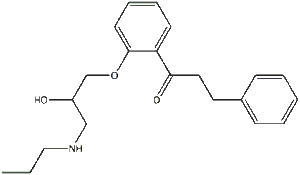
Chemical Name: Paraffin Wax
Product Fat Content: %3-4
INCI Name: Slack wax (petroleum)
PEARL Name: Slack wax (petroleum)
General Trade Name: Paraffin Wax
English Name: Paraffin Wax
Turkish Name: Paraffin Wax
CAS Number: 8002-74-2
EC Number: 267-008-6
IUPAC Name: Alkanes, C20-40
Areas of Use: Suitable for use in wax and vaseline production
E-Code: None (Not used as a food additive)
1. Brief Description of Paraffin Wax
Paraffin Wax (Slack wax – petroleum), Our product used in the production of wax and vaseline is a brown, solid substance with a slight petroleum odor obtained from petroleum. This product, which has an oil content between %3 and %4, has a wide range of uses.
Paraffin wax It occurs mostly as a white, odorless, tasteless, waxy solid, with a typical melting point of about 46 to 68 °C (115 to 154 °F) and a density of about 900. It is insoluble in water, but soluble in ether, benzene, and some esters. Paraffin wax is generally classified as a stable chemical, as it is unaffected by most common chemical reagents but burns readily.
Paraffin wax, is the common name for a mixture of solid higher alkanes, the molecular formula is CnH2n+2, where n=20-40. The excess oil residue in the wax is removed by the petroleum refining process. The oil is then removed and separated by vacuum distillation. The main component of refined paraffin is saturated normal alkanes with a carbon number of about 20-40, with small amounts of isomers and alkanes.
2. Paraffin Wax Areas of Use and Usage Rates
Paraffin Wax is widely used in the following areas:
- In wax production
- In the production of vaseline
- Cosmetics and personal care products: (%1-10)
- Candle production: (%60-100)
- Rubber industry: (%2-5)
- Furniture polishes and varnishes: (%5-20)
- Food coatings (e.g. cheese coating): (%3-8)
- Textile industry: (%2-10)
- Paper industry: (%3-15)
- Tablet coatings in the pharmaceutical industry: (%1-3)
3. Physical Properties of the Product
- Appearance: Brown solid wax
- Smell: Light petroleum odor
- Melting point: 70°C – 76°C
- Freezing point: 68°C – 76°C
- Intensity: 0.88 – 0.94 g/cm³ (at 20°C)
- Fat content: %3 to %4
- Resolution: Insoluble in water, soluble in organic solvents (e.g. toluene, hexane).
4. The product Chemical Properties and Molecular Formula
Paraffin Wax It consists mainly of long-chain hydrocarbons (C20-C40).
General molecular formula: C_nH_(2n+2). It is chemically inert, does not show acidic or basic properties and has a stable structure.
5. Paraffin Wax Other Names
- Turkish: Paraffin wax, Petroleum Wax
- English: Paraffin wax, Petroleum wax, Slack Wax
Product Trade Names:
Merwax BR 1634, 9,9,23-tributyloctatriacontane; pentacontane
A complex combination of hydrocarbons obtained from a petroleum fraction by solvent crystallization (solvent dewaxing) or as a distillation fraction from a very waxy crude. It consists predominantly of saturated straig …
Petroleum
Prowax 390
Slack wax
6. Useful Links
PubChem Page: Paraffin Wax (8002-74-2)
Safety Information page: Slack wax (petroleum) – PubChem
7. Product Safety and Storage Information
- Storage: Should be stored in a cool, dry, ventilated place and away from direct sunlight.
- It is flammable and should be kept away from open flames and high heat sources.
- May be harmful if inhaled, contact with skin in molten form may cause severe burns. Appropriate protective equipment should be worn.
8. Remarkable Information About the Product
- Paraffin Waxis the most preferred raw material in candle production worldwide.
- It is a product used safely in the food industry, especially for cheese coating (known with the code E905). This product is not food grade.
- It is widely preferred in the cosmetics industry for skin moisturizing and protection purposes.
- It is considered a safe and stable raw material because it has low reactivity.
9. Frequently Asked Questions and Answers About Paraffin Wax
1. Is Paraffin Wax harmful to human skin?
It does not cause any harm when processed under appropriate conditions and cosmetic quality standards are met.
2. Can Paraffin Wax be used in food?
Yes, paraffin wax can be used as a food coating under certain conditions with code E905. This product is not food grade.
3. What is the fat content of the product?
Generally, the fat content is between %3-4.
4. Is Paraffin Wax soluble in water?
No, it is insoluble in water but soluble in organic solvents.
5. Why is Paraffin Wax preferred in candle making?
The stability, suitable melting point, economy and burning properties of paraffin wax make it preferred in candle making.
6. Is Paraffin Wax flammable?
Yes, paraffin wax is flammable. It should be kept away from fire and heat sources when stored.
7. What are the storage conditions for Paraffin Wax?
It should be stored in cool, dry environments away from sunlight.
8. Is Paraffin Wax a petroleum derivative?
Yes, it is obtained by refining crude oil.
9. For what purposes is Paraffin Wax used in cosmetics?
It is preferred as a moisturizer, protective barrier creator and thickening agent.
10. What is the difference between Paraffin Wax and microcrystalline paraffin?
Paraffin Wax has larger crystalline structure and lower melting point, while microcrystalline paraffin has smaller crystalline structure and higher melting point.
| Weight | 1 kg |
|---|---|
| Case NO | 64742-61-6 |
| INCI Name | Slack Wax (petroleum) |
| English Name | Paraffin Wax |
| Amount | 1kg |
| Brand | HoChem Chemistry |
Sample Formula with Paraffin Wax
Sample Wax Formula with Paraffin Wax
Raw Materials Used and Their Proportions:
| Raw Materials | Ratio (%) | His duty |
|---|---|---|
| Paraffin Wax (%3-4 oily) | %40 | Provides rigidity and grip |
| Rosin | %35 | Provides adhesiveness |
| Beeswax | %15 | Provides flexibility and softness |
| Vaseline (Petrolatum) | %5 | Provides softness and lubricity |
| Glycerine | %3 | Provides moisturizing |
| Titanium Dioxide | %1 | Gives consistency and color |
| Essence (optional) | %1 | It gives off a smell |
Total: %100
Wax Preparation Method (Production Method):
Step 1: Melting Process
- First put it into a clean and dry boiler Paraffin Wax, Rosin resin And Beeswax add.
- Melt the mixture by heating it at approximately 80-90°C. (Do not use direct flame, bain-marie method is recommended.)
Step 2: Homogenization
- Once the melting process is completed, the temperature is kept constant and Vaseline (Petrolatum) is added and mixed homogeneously.
Step 3: Addition of Contributions
- After the mixture becomes homogeneous, Glycerine, Titanium Dioxide and finally optional essence is added.
- Stir for approximately 10-15 minutes until well mixed.
Step 4: Cooling and Packaging
- The ready wax mixture is carefully filled from the production container into the packaging containers.
- The product is cooled to room temperature in the packages and allowed to harden.
- After packaging, the product is closed, labeled and ready for use.
Advantages of Paraffin Wax Wax:
- Easy to apply and spread structure.
- Provides minimum irritation to the skin.
- Provides flexible and effective results.
- The product has a long shelf life (approximately 2-3 years).
Usage Recommendations:
- Clean and dry the area before applying wax.
- Melt it at a suitable temperature (usually 40-45°C) and apply it in a thin layer.
- Apply the waxing cloth and pull it quickly without stretching the skin.
- After the procedure, clean the skin with a suitable lotion or oil.
Paraffin Wax Frequently Asked Questions
Frequently Asked Questions and Answers About Paraffin Wax
- What is Paraffin Wax?
Paraffin WaxIt is a white or yellowish, crystalline solid wax obtained by refining petroleum. It contains approximately %3-4 oil and has a wide range of uses in various sectors.
- Is Paraffin Wax Harmful to Health?
Quality, purified Paraffin Wax It is generally safe. However, it should be noted that it is flammable and contact with skin while molten can cause severe burns.
- Why Is the Oil Content of Paraffin Wax Important?
Paraffin Wax's oil ratio determines the hardness, flexibility and usage area of the product. Paraffin wax containing %3-4 oil is ideal for cosmetics and personal care products.
- Can Paraffin Wax Be Used in Food?
Yes, it is known in the food industry with the code E905. Paraffin WaxIt is used to prevent moisture loss and extend the life of the product in the surface coatings of products such as cheese.
- Why is Paraffin Wax Used in Cosmetic Products?
It is used in cosmetic products due to its structure that protects the skin, moisturizes, increases consistency, creates a protective barrier and provides smoothness to the skin.
- Is Paraffin Wax a Natural Substance?
No, Paraffin Wax is a petroleum derivative. However, when it is well refined, its purity increases and it is safe to use for human health.
- What is Paraffin Wax Food Grade?
It is a type of Paraffin Wax that is allowed to be used in the food industry, has undergone special purification processes and is documented to be suitable for health (products with the code E905 fall into this class).
- What is the Best Way to Store Paraffin Wax at Home?
Paraffin wax should be stored in cool, dry and well-ventilated areas, out of direct sunlight. It should be kept away from open flames or high heat sources.
- What is the Melting Point of Paraffin Wax?
Paraffin Wax generally has a melting point between 45°C and 68°C, depending on its type and refined quality.
- Is Paraffin Wax Flammable?
Yes, Paraffin Wax is flammable. It should be kept away from open flames when used, and the hot melting process should be done in a controlled manner.
- What are the differences between paraffin wax and beeswax?
Beeswax is a natural and animal-based wax (produced by bees) while Paraffin Wax is petroleum-based. Beeswax is more flexible, softer, and has a natural scent.
- Can Paraffin Wax Be Used Alone in Waxing?
It is generally not used alone because pure paraffin wax is hard and brittle. It is made by mixing it with raw materials such as beeswax and resin.
- Is Paraffin Wax Harmful to the Skin?
Purified and cosmetic grade Paraffin Wax is not harmful to the skin. However, poor quality or low purity products may cause skin reactions.
- Does Paraffin Wax Mix With Water?
No, Paraffin Wax is not soluble in water. However, it is soluble in organic solvents such as hexane, toluene, and more.
- Why is Paraffin Wax Preferred in Candle Making?
Paraffin Wax is preferred in candle production because it is economical, burns cleanly, can be shaped easily and can be produced in large quantities.
- Is Paraffin Wax Harmful If Swallowed?
Small amounts of food grade Paraffin Wax are generally not harmful if accidentally consumed, but consumption of large amounts may cause gastrointestinal upset. Do not ingest.
- Is Paraffin Wax Environmentally Friendly?
Since paraffin wax is derived from petroleum, it is less environmentally sustainable than natural waxes such as beeswax. However, it is recyclable.
- What is the shelf life of paraffin wax?
If stored under appropriate conditions (in a cool, dry, sunless environment), the shelf life of Paraffin Wax is approximately 3-5 years.
- Can Paraffin Wax Be Cleaned With Water?
No, Paraffin Wax cannot be cleaned with water. Oil-based solvents or organic solvents should be used for cleaning.
- Can Paraffin Wax Be Applied to Hair?
It is not used directly in hair care, but it can be found in small amounts in some hair styling products as a thickener and stabilizer.
- Are Additives Used When Making Candles with Paraffin Wax?
Yes, paraffin wax can be mixed with substances such as beeswax, stearin, microcrystalline paraffin or petroleum jelly to increase the flexibility of the wax.
- Is There a Risk of Allergy to Paraffin Wax?
It generally carries a low allergic risk, but in rare cases, sensitization may occur in people with very sensitive skin.
- How to Melt Paraffin Wax Safely?
It can be melted safely using the double boiler method (bain-marie method) or in heaters with precisely controlled temperature. Direct fire should be avoided.
- Can Paraffin Wax Be Used on the Face?
Special cosmetic paraffin masks can be used in skin care, but should not be applied directly to the skin in molten form. Professional application is required.
- Is Paraffin Wax Biodegradable?
No, it is not biodegradable in nature and is persistent when released into the environment.
- What is the Main Difference Between Paraffin Wax and Microcrystalline Wax?
Microcrystalline paraffin has a smaller crystal structure, higher melting point and flexibility. Paraffin Wax has a larger crystal structure and lower melting point.
Be the first to review “Parafin Wax | Ağda & Vazelin Parafin | Slack Wax | 64742-61-6”
Related products


All Raw Materials

All Raw Materials
Glycerin Monostearate | Glyceryl Stearate | 31566-31-1 | GMS


All Raw Materials


All Raw Materials

All Raw Materials

All Raw Materials


All Raw Materials

All Raw Materials


 Turkish
  English
Reviews
There are no reviews yet.